The Studio Sound Myth: Recording Does Not Erase the Room
Studio sound does not erase the room: learn to hear how performance, space and recording choices leave distinct traces in a finished recording.
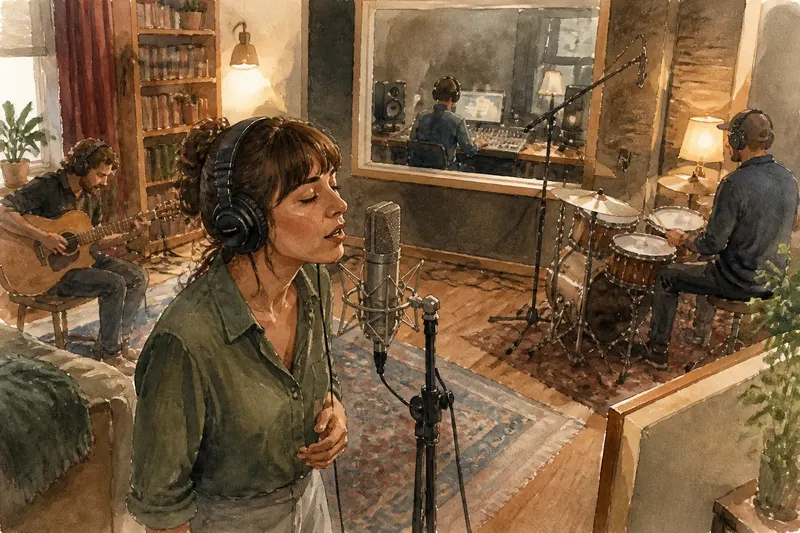
A singer leans towards the microphone for a quiet line, then turns slightly away for a louder one. The room is not silent between those gestures: a short reflection may follow the voice, and the singer’s movement changes what reaches the microphone. Studio sound does not erase the room; it can preserve, reshape or conceal its character, depending on what the musicians and engineer choose to capture.
The useful question is not whether a recording is “live” or “studio-made”. It is which traces of place remain, and whether they help the music. A dry vocal recorded in a treated booth can still carry the singer’s breath, distance and phrasing. A recording made in a large room can sound close and controlled if microphones are placed near the instruments and reflections are reduced in the mix.
Start with the sound you want
Think of room character as the audible result of sound meeting a physical space. It may include reflections, reverberation, low-frequency resonance, background noise and the way an instrument’s tone changes with position. Those traits are not automatically flaws. A lingering reflection can make a sustained note feel open; a cramped-sounding resonance can crowd a busy arrangement.
Recording choices determine how strongly these traits enter the finished track. Microphone distance affects the balance between direct sound and reflections. Direction matters too: a microphone aimed at a singer may pick up a different blend from one pointed towards a wall or the room’s broader sound. Later, equalisation, editing and reverberation can alter the impression, but they do not make every captured interaction disappear.
For a decision guide, begin with the musical purpose. Ask whether the room should feel present, merely support the performance or stay largely out of the way. Then consider the sound source, arrangement and available space. The same room may suit a solo voice and frustrate a closely packed drum part, because each asks for a different relationship between direct sound and reflection.
For close, intelligible vocals
If the words and small changes in expression need to sit clearly at the front, a close microphone and a quiet, controlled space often fit. The microphone receives a strong direct signal relative to the room, so consonants and breath can remain easy to hear. This approach does not make the singer sound placeless: phrasing, vocal tone, microphone angle and the quality of the surrounding silence still shape the result.
A very dry recording can also feel exposed. A singer may sound more connected to the track when a modest room reflection or carefully added reverberation supplies a sense of depth. The choice is not simply “room” versus “no room”; it is how much space supports the performance without obscuring its details.
Say you are recording a soft vocal in a furnished spare room, with a duvet hanging nearby to reduce a strong reflection from a bare wall. If the singer’s words remain clear but the voice feels too close and flat, you might keep the performance and add a subtle reverberant tail during mixing. The expected audible change is a little more perceived distance, not the disappearance of the original room or a transformation into a concert hall.
For instruments that need air
Acoustic guitar, piano, strings and some percussion can benefit from hearing more than the immediate sound at the instrument. A microphone placed farther away captures a greater contribution from reflections, which may give the performance a sense of scale and continuity. That can be a good fit when the arrangement has room for those details and the space responds pleasantly to the instrument.
The trade-off is that distant capture also brings more of the room’s unwanted features. A boxy resonance may build up around a particular note; a fluttering echo between hard walls can make repeated attacks distracting. Moving an instrument or microphone can change the balance, but there is no universal placement that works in every room. Listen to the instrument while it is being played, not only to the room when it is empty.
A treated room is not necessarily a dead room. Soft furnishings and purpose-built acoustic panels can reduce some reflections, while a wooden floor, windows or a large ceiling may continue to contribute. For an instrument-led arrangement, a moderate sense of space may fit better than either a heavily damped recording or a long, obvious reverberation.
For dense arrangements
When many parts occupy similar musical territory, room sound can blur their boundaries. A shared reflection may make a guitar, keyboard and vocal seem to occupy the same space, even if each was recorded separately. In that situation, closer capture and a more controlled room can make individual parts easier to place in the mix.
That does not mean every track should be made completely dry. If all the instruments are close and sharply defined, the finished arrangement can feel disconnected. A shared room microphone, a common reverb setting or a few instruments recorded in the same space can suggest a coherent environment. The useful distinction is between deliberate shared space and accidental clutter.
For drums, room microphones can capture the way a kit excites the space, including the combined sound of several drums and cymbals. This can add breadth and energy, but it may also make cymbal wash dominate or extend into gaps where the arrangement needs clarity. A close-miked kit can be easier to shape, though it may need another source of ambience to feel connected.
For a room you cannot change
Home recording, rehearsal rooms and borrowed spaces impose practical limits. If a room has an obvious ringing reflection, changing the recording position or microphone direction may help more than adding equipment. A thick rug can affect reflections from the floor, while bookshelves, curtains and upholstered furniture create a less uniform surface than a bare wall. These are ways to influence the sound, not a promise that the room will become acoustically neutral.
Listen for the problem that matters most. A low, sustained hum differs from a sharp reflection; a neighbour’s traffic differs from a resonant note that follows the instrument. Each calls for a different response. A hum may need its source identified, while a reflection may be less prominent after changing the singer’s position or using a more directional microphone. If the source is electrical or otherwise safety-related, seek appropriate professional help rather than attempting a repair from recording advice.
Some room character is part of the performance. A floorboard creak, a breath before a phrase or the changing distance between player and microphone may make a take feel human. Keep such sounds when they contribute to the music; edit them when they distract. The decision belongs to the intended listening experience, not to a blanket rule that every non-musical sound must be removed.
Questions about room sound?
Can mixing remove a room completely?
Mixing can reduce or mask some room traits, but it cannot always separate them cleanly from the instrument or voice. Strong reflections are captured together with the direct sound, so removing them may also alter the source’s tone.
Does a studio microphone make a recording sound professional?
A microphone is one part of a recording chain, not a substitute for a suitable space and a well-managed performance. The source, placement, room and arrangement all affect whether the result feels clear and intentional.
Is a dry recording the same as a close recording?
Not exactly. “Dry” describes little audible reverberation, while “close” describes the microphone’s relationship to the sound source. A close recording can still include room sound, and a more distant recording can be made in a relatively controlled space.
When should room sound be kept?
Keep it when it supports the performance’s mood, scale or connection between instruments. If it masks words, softens important attacks or draws attention away from the music, reduce its prominence or choose a more controlled capture.
Choose the trace, not the myth
The best choice depends on what a listener should notice first. For intimate vocals, control the room enough to preserve words and expression. For instruments that need depth, allow useful reflections to contribute. For dense arrangements or imperfect spaces, prioritise clarity and introduce ambience selectively. These are starting points rather than fixed prescriptions, since instruments, performers and rooms behave differently.
Studio sound does not erase the room; it makes the room’s role adjustable. A reflection can be part of an instrument’s tone, a quiet space can protect a delicate vocal, and a shared ambience can help separate tracks feel as if they belong together. Listen for the trace that serves the music, and treat the rest as a choice about what to leave outside the frame.