Lyrics First or Melody First? Two Ways into a New Song
Lyrics first or melody first? Follow one imagined songwriting session to see how each starting point shapes a draft and how to move past a stall.
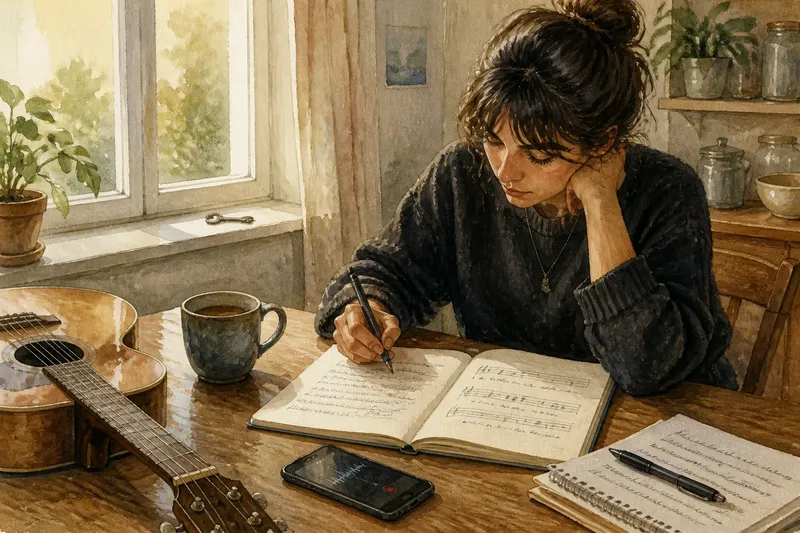
At a kitchen table, a songwriter opens a notebook beside a guitar and a mug gone cool. The question is whether to begin with lyrics first or melody first: one route gives the song a thought to carry, while the other gives it a sound to follow. In this imagined session, Mara tries both on the same subject and notices how each choice changes the first draft.
One subject, two starts
Mara wants to write about leaving a familiar place. She has no finished story, only a small image: a key left on a windowsill after someone has moved out. That image is specific enough to suggest feeling without deciding what the song must mean.
To keep the comparison useful, Mara uses the same image for both attempts. She does not try to make either draft polished. A first draft is a working sketch: its job is to reveal which phrases, sounds and turns might support a complete song.
Beginning with lyrics
Mara writes a few lines in ordinary speech before reaching for the guitar. She records the action plainly: the room is empty, the key remains, and the person who left has not returned for it. This gives her a sequence of events and a point of view to shape.
She reads the lines aloud, listening for natural stresses. In a lyric, stress is the emphasis a speaker gives a word; a sung phrase often feels awkward if its strong beat lands on a word that would normally be unimportant. Mara circles the words that carry the thought, such as “key”, “window” and “left”, then trims a line that explains the image rather than letting it work.
Now she speaks the lines in different rhythms. One line falls into a short, clipped pattern; another stretches towards its last word. She hums lightly over the speech, allowing the cadence to suggest pitches without forcing a full tune. The lyric-first route has given her a clear scene and a reason for the song to move from one line to the next.
Its difficulty appears when Mara tries to make every line say something important. She has filled the page with explanation, leaving little room for repetition, breath or a memorable phrase. She gets unstuck by choosing one line as the centre of the verse and treating the surrounding lines as support, not as further evidence.
Beginning with melody
For the second attempt, Mara puts the notebook aside and plays a loose, wordless tune on the guitar. She records it on her phone so she can listen without continuing to play. The melody begins with a compact phrase, then rises and hangs on a longer note. Even without words, that shape suggests a question followed by a moment of waiting.
She sings the tune with temporary syllables, such as “da” and “oh”, rather than choosing words immediately. These placeholders help her notice where the tune needs a short syllable, where a vowel can be sustained and where a breath might fit. They also keep her from cramming a complete sentence into every musical space.
Next, Mara asks what kind of language the tune can hold. The longer note seems to invite a word with an open vowel; the quicker notes may suit conversational details. She returns to the key on the windowsill, but now the image has to fit the tune’s accents and lengths. A phrase that worked on paper may need a different word order when sung.
This route can stall in a different way. Mara likes the sound of the wordless phrase but cannot tell what the song is about. If she keeps adding attractive syllables without choosing a point of view, the tune may remain a sketch with no lyrical direction. She gets moving again by writing several plain sentences about the image, then testing only the most singable fragments against the melody.
Where the drafts diverge
The lyric-first draft has a clear narrative path: someone leaves, a key stays behind, and the empty room holds the final image. Its main editing task is to make the language less explanatory and more singable. The melody-first draft has a stronger sense of shape from the outset, but it needs words that give that shape a distinct subject.
Neither draft is automatically more honest or more musical. Starting with lyrics can make it easier to preserve a precise thought, yet the tune may need to accommodate lines of uneven length. Starting with melody can make phrasing and breath feel intuitive, yet the writer may have to work harder to avoid generic words. These are tendencies, not rules: a songwriter can switch routes as soon as the first idea has done its work.
In Mara’s case, the useful result is not a choice between the two sketches. She keeps the first attempt’s concrete image and borrows the second attempt’s rising phrase for the line that turns towards the empty room. She adjusts the lyric until its natural emphasis lands comfortably in the tune, then removes a line that repeats information the image already supplies.
Questions at the table?
Should a beginner start with lyrics or melody?
Start with whichever arrives more readily: a line you want to say or a tune you want to hum. If one route repeatedly stalls, changing the starting point can expose what the draft is missing.
Can lyrics and melody be written together?
Yes. A writer can move between a spoken phrase and a sung one, changing the words as the tune develops. The important thing is to notice whether each change makes the thought clearer and the phrasing more natural.
How do I fit words to a melody?
Sing the line slowly and listen for the tune’s strong beats, long notes and places to breathe. Try words whose spoken emphasis and vowel sounds sit comfortably there, then revise the sentence rather than forcing every original word to stay.
What if my first draft sounds awkward?
Keep the part that is working and identify the source of the snag: unclear meaning, unnatural word stress or a tune with no room for the phrase. A small revision to one line or musical gesture can give the next draft a clearer direction.
Choose a useful start
Lyrics first or melody first is best treated as a question about what the song needs before anything else. If the subject feels vague, begin with a concrete line or image. If the words feel stiff, set them aside and find a rhythm or contour that opens up the phrasing.
Mara’s imagined session ends with a draft that borrows from both routes, but another songwriter might keep one approach throughout. The useful habit is to preserve the first spark, then check how words and tune affect one another: a lyric must sound like something a person could sing, and a melody gains purpose when its shape helps the lyric turn.